Drinking Together Whilst Apart 2014
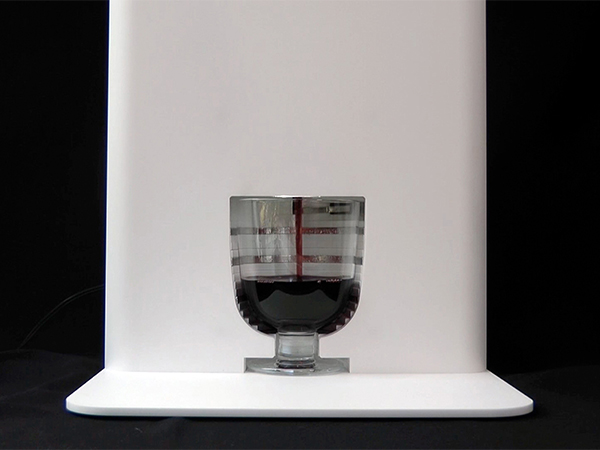
Drinking Together Whilst Apart is one of five machines we built for the Family Rituals 2.0 project, seeking to understand the challenges of working away from home. The machines are playful and provocative; they are not solutions to the problem of absence from home, but rather a way of provoking conversations about the family's attitudes to home and work life.
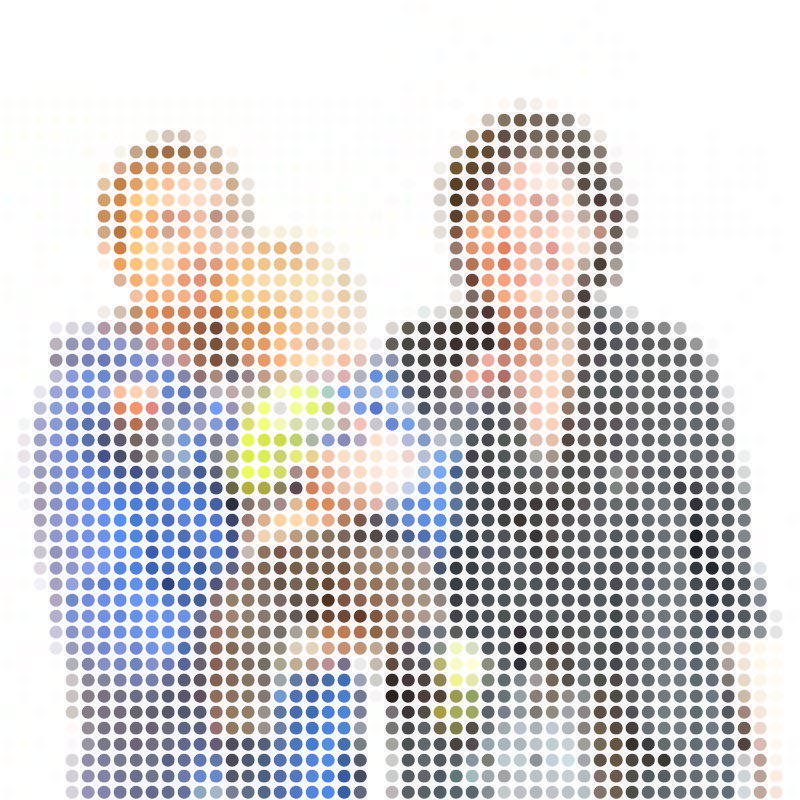
Craig, Holly and their two‑year‑old son Sam live in Edinburgh, where Craig works as a consultant in the financial sector and Holly is a public relations professional. Craig is frequently away from home for two or three nights during the week, visiting clients in London and the south of England. Holly is now establishing her own company, working from home, and she is Sam's primary carer.
We designed and built a bespoke technology for Craig and Holly that would create moments of reflection for them, allowing us to talk about their work/life balance and their attitudes to working away from home. We framed this around the everyday rituals of the home that are missed in separation.
Getting to know Craig and Holly through interviews and the materials they generated from a set of cultural probes revealed glimpses of their working lives with the pleasures and strains of being parents to an inquisitive toddler. From this material we were looking to find an existing quotidian ritual that we could extend or to find inspiration for something new. We focused on their shared pleasure of having a drink together at the end of the day when Sam is finally asleep and they have "done all the serious stuff."
Drinking Together Whilst Apart pours a glass of wine at home when an electronic beer‑bottle opener is used remotely, connecting via an iPhone app. An alert is generated on the iPhone whenever (and as often as) a glass is placed in the machine. The machine will not pour unless there is a glass present. While we assumed Holly would be at home and Craig would be away, we did not explicitly require or suggest this; it was up to the family to make sense of the design. The machine lived with them for three months.
While Holly and Craig greeted the machine with a good deal of approval and excitement, there was soon a note of hesitation. They worried we had focused on a ritual that might be framed by wider health narratives about drinking.
"We are not alcoholics but we do like to have a drink, and we do, like most of the country, think 'Oh, we really should cut back.'" — Holly
After unpacking there was an immediate problem: the machine would not fit anywhere in the kitchen. With the bottle inserted it was too tall to fit under their units; there was nowhere for it to be placed out of Sam's reach. After a period of weeks we became aware that the machine had not been used and, as the date of retrieval drew closer, we asked Craig and Holly to make a special effort to use it.
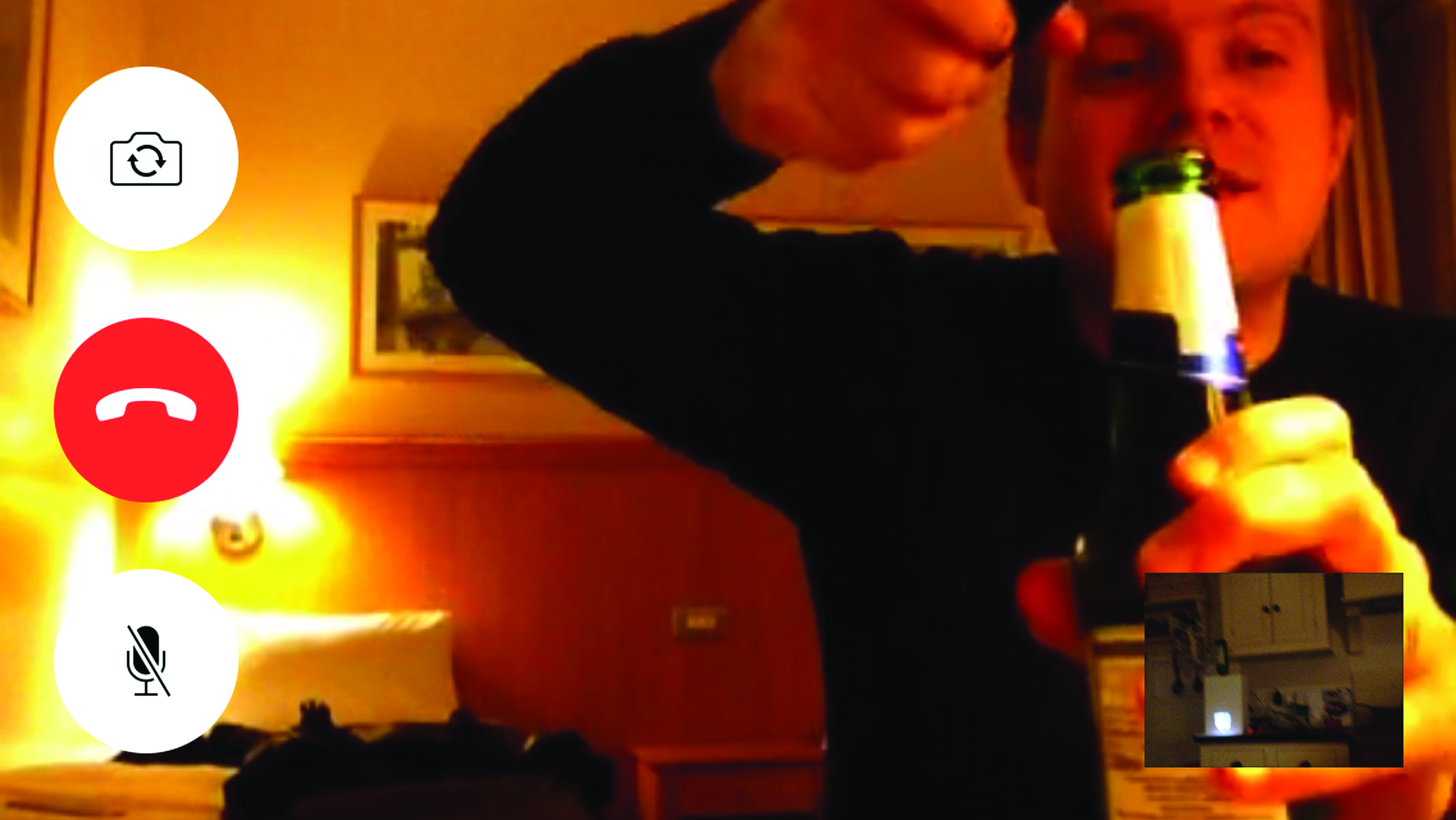
"There was actually the final D‑Day. Gary was round, just for dinner, and we were like, right, let's do it! And we did. It was funny that I actually had somebody with me here when we finally did use it. I think that it really showed, actually, that I don't really drink that much on my own, even if Craig was actually on the other side on Facetime... If I am going to have a drink, I would rather have a drink when he is here rather than on my own." — Holly
On the day of collection, we found the machine stored on a shelf, unplugged, next to an unused bread maker. There had been no place for this ritual to establish itself. There could be no casual interactions with the machine; on each occasion it would have to be temporarily set up and then packed away.
As we spoke to Holly and Craig it became clear how complex the moment we had designed was: all the conditions needed to be correct — the machine on, a bottle of wine opened, Sam quietly asleep, Craig having remembered the bottle opener, and Craig being somewhere he felt comfortable to drink. That combination rarely occurred.
The wine dispenser contains a Wi‑Fi‑connected Arduino Yun controlling a high‑torque servo motor that mechanically operates an unmodified wine optic. Sensors detect the glass, and LEDs illuminate it when inserted. The bottle opener senses the presence of a bottle top in its teeth by conduction and communicates to the iPhone via a Bluetooth 4.0 module. We use yaler.net to operate behind the home router.
Displayed at the Science Gallery's HOME\SICK show (May 2015) and at the London Design Festival (September 2015).
This was developed at Open Lab, Newcastle University, in collaboration with the Helen Hamlyn Centre for Design at the Royal College of Art, as part of the Family Rituals 2.0 project funded by the EPSRC.
Credits:
Ethnography: Paulina Yurman, David Chatting
Design: David Chatting, Paulina Yurman, David Kirk
Fabrication: Zone Creations, David Chatting, Paulina Yurman
Electronics, software and mechanics: David Chatting
Film: David Chatting (with thanks to Mark McKeague)